Every time your child recalls what she is learning, she thickens the neural pathways to that information in her long term memory. Research shows that recall practice is more powerful than almost any other learning strategy. You can help your child accelerate this process by routinely asking questions about what she is studying.
What did you study today in math?
Explain to me how to solve this kind of problem.
What are the reasons this historical event happened?
Tell me about the process of photosynthesis again.
Every time your child recalls specific details or re-solves a problem, such is 3×5, that information becomes slightly more fixed in his long term memory. And he becomes just a bit faster at retrieving it.
Once your child can retrieve this information effortlessly, move on to retrieving newer learning.
2. Question It
This is what a healthy brain does: It craves new information because learning fuels cognitive growth. Without effort, your child’s brain calls questions to mind to pique his curiosity and to motivate him to engage in learning. Raising questions. Asking questions. Pondering questions. These are the indicators of a healthy, growing brain.
Your child participates in this process by purposefully raising questions about what she is learning—Don’t require her to immediately find answers. It is merely enough for her to ponder questions about the subjects she is studying.
You can maximize this strategy by asking your child to write his questions from the school day in a special journal. He doesn’t have to write the answers down—just the questions. You don’t want to make this task laborious. It should be fun and rewarding.
At the end of each week, sit down and discuss these questions with her—talk about any answers she may have found or theories she has formulated. Ask what new questions have emerged. The act of raising questions about what she is learning fires active learning—a brain on high alert for answers—a brain primed to make connections to prior learning—a brain attentive to the subjects she is studying.
If your child asks you to answer a question he has—please do! But otherwise, just let the answers present themselves naturally over time.
3. Draw It
Finally, ask your child to use that special journal to draw pictures about what she is learning. We think in pictures. We remember more details about information and events attached to images (not words). As we read text, we convert what we are reading into a movie in our mind—the words themselves do not scroll across the screen—the pictures we associate with them do.
Again, just as with the previous two strategies, we can contribute to these automatic brain activities by intentionally engaging in them—drawing a picture about the word problems from a math lesson or the processes in a science book or the events in your history studies will help him remember more details about those lessons.
Want to know the 20 Power Tools of Learning? Download a free printable here.
My daughter, Kayte, a second-generation homeschool mom, and I have long talked about doing a podcast together (we are podcast junkies ourselves). With her persistence and technical knowhow, we finally found the time to pull it off. Our first two seasons are in the can and available on your favorite podcast app.
In our very first episode or our new Homeschool Works podcast, Kayte and I look at the research behind why homeschooling works. Everything we cover will help you focus on what’s most important in the design of your own home school. Spoiler alert, it is all about tailoring to the unique needs of each child. And we have suggestions on how to actually make that happen. We’re also going to be talking about interest, and why it’s so important to spark our kids interest. Before we start teaching them. We close out with ideas on how to pique the interest of your most reluctant learner, I learned so much while recording this episode with my mom, and I’m really excited to share it with all of you. So why well, the school works? What’s the purpose of this podcast? Like? What were we thinking when we decided to start this?
After I finished homeschooling our kids, I headed back to school to complete a Ph.D. in educational psychology. I wanted to know how kids learn best. Wouldn’t that be helpful information for homeschooling moms and dads?
Researchers have studied how children learn for more than a hundred years. We have a substantial body of knowledge and consensus among scientists on many aspects of learning. One day in class I had an ah-ha! moment. I realized all our research points to one obvious conclusion:
If we built a school based on how kids learn best . . . we’d build a home.
How’s that for some liberating good news? And, doesn’t it make complete sense? A child’s optimal learning environment is the one God designed: a family.
Now, here’s the caveat—we can miss the opportunities our homes afford our kids to learn. We’ve got to nurture the advantages and eschew practices that undermine their learning.
Let me unpack this with eight major findings. (These results should correlate with your own learning experience. How kids learn best and how adults learn best is not that different.)
Kids learn best when they believe their teacher and fellow students care about them.
Have you ever taken a class where the teacher didn’t even know your name? Worse, how about a situation where you suspected that the teacher or another student didn’t like you? What did that do for your confidence and motivation? Think about the effect circumstances like these would have on each of your kids. Conversely, think of a learning situation you really enjoyed or you put forth your best effort. Was the teacher or mentor personally invested in your success and well-being? Did you feel included? Didn’t that help you to push yourself?
No one cares more about your kids than you do. There’s a lot of power in this truth—even the best teachers can’t be invested in them like you are. When conflict arises, hit pause. Wrap your arms around your brood and talk it through. Learning will be a slow slough until relationships are restored. (And, celebrate the freedom you have to hug your kids. Sadly, classroom teachers can’t do that anymore.)
Motivation skyrockets when we fill our homes with affirmation. I posted notes in strategic places to remind myself to be nice and praise my kids (but I’m sure you don’t have this problem). Get your kids in on the game plan too. They need to know that they have a lot of power to undermine or propel your success and the success of their siblings. You will be the best homeschool teacher possible when you feel loved and affirmed. And, your children’s learning will soar in an atmosphere that exudes warmth and affection.
Kids learn best when they have opportunities to pursue their interests.
As a classroom teacher, I knew this. But, I just couldn’t allow ninety students that freedom–I was paid to keep them in their seats and away from the windows. No, you can’t look outside! Eyes front while I teach you about what is out there. What a shame because interest indicates readiness. Is your child interested in what the letters on the page mean? Then your child is ready to learn how to read. Is your child curious about dinosaurs? Then dive in now before his or her interest wanes.
Our son, Gabe, got fascinated with the physics of flight when he was seven. What a joy to have the ability to drop what we were doing and head to the library to check out all the books on the topic. Many were way above his reading level, but his interest accelerated his comprehension. Dad bought Estes rockets and taught Gabe how to launch them from our backyard. (Neighborhood kids were asking to be homeschooled when they saw all the action at our house!) We all went to an airshow. Even Gabe’s siblings and moi got caught up in his enthusiasm for flight. By the end of his exploration, Gabe could explain how planes fly better than most high school students–even I remember what we learned to this day.
Think of the lost opportunity if I had said, hang in there, buddy, we’ll get to that in fifth grade.Right now the second grade science standards require us to study plants. It’s a good thing we took advantage of Gabe’s interest when it appeared. By fifth grade he was no longer interested in flight. His attention had turned to rocks.
Interest is powerful stuff–go with it. It awakens the brain and facilitates deeper learning. Homeschooling works when kids have a lot of freedom and leisure to follow their own pursuits. It empowers them, and they’ll take more responsibility for their education. Fill your home with fascinating, worthwhile things to explore. Banish the media and twaddle to a dark corner or grandma’s (guilty). Then sit back and watch the magic–or better yet, dive in with them.
Kids learn best when they can make choices and participate in decisions about their learning.
Test this against your own experience. How much motivation would you have if someone made you homeschool your kids? How about if someone else assigned the curriculum and determined the schedule you follow? Doesn’t this finding make complete sense? When we have no voice or control, our motivation wanes. We invest the greatest time and effort in areas of our lives where we have freedom to choose and the opportunity to be heard. Kids are wired just like we are.
This doesn’t mean we have to let our kids run the show—but they should have a seat at the table. Give your kids as much choice and involvement as their age and maturity allows. Young children can choose between two books to read; teens are ready to choose what classes to take. Young kids can participate in setting the schedule for the day; teens can manage their time. Invite younger kids to weigh in on the curricula you are considering, while teens can bring their choices to you for your thoughts. A collaborative relationship with your kids may feel time-consuming at first, but you will be so glad you went this direction as your teens take on more and more responsibility, and your time is freed up to concentrate on little ones.
Kids learn best when they can observe older students who model what success looks like.
Kids learn more in a multi-age setting than a room filled with age-mates. (It’s why the one-room schoolhouse worked.) A multi-age setting allows younger kids to see older kids achieving success in areas they are just starting to learn about. This visual gives them confidence that, with time and effort, they too will achieve success. Peer modeling also makes the steps involved in progress apparent. Having only an adult (like a teacher at the front of the room) as a model of success is too big a gap.
If your child is the oldest of siblings or an only child, join a co-op or activity that includes kids of multiple ages. Our homeschool drama troupe has a wide range of ages in our productions—it is striking to note the acting chops our youngest members have by the time they reach high school. They’ve had the advantage of watching the kids ahead of them go from stage fright to accomplished actors. Keep this finding in mind—kids learn more from observation than instruction.
Kids learn best when they have a teacher who is available to provide feedback and support.
I believe I was a dedicated high school English teacher. But with ninety students a day, my goal was to return essays within a week. Even that was too big a lag between submitting the assignment and receiving feedback. My students’ lives were eons beyond that assignment by the time I returned their papers—few gave my feedback more than a glance. The more immediate the feedback, the more useful it is to students.
I remember a day my youngest, Kristen, was working on some math exercises. As I took a moment to observe her progress, I saw she was forgetting to carry and borrow when needed. It was a simple matter to review those steps together and have her correct her mistakes. (No tears. No drama.) What a different story if I hadn’t looked at her work until the end of the week—she would have completed several math pages by then and repeatedly reinforced her mistakes. The more we practice a procedure incorrectly (like solving a subtraction problem) the more difficult it is to unlearn our errors.
I realize that your time is limited—so prioritize being available when kids are learning the proper procedure for completing a task. With other types of assignments, I asked my kids to schedule appointments with me if they wanted help on a project or composition. I always tried to get with them within the day. Being available to help when asked is key. (You can also involve older siblings in this responsibility—explaining something to a younger child reinforces learning in both students. Isn’t that amazing? Another finding that explains why homeschooling works!)
Kids learn best when what we ask them to do matches what they are ready to learn.
God has created this fabulous process called development, and each kid has a unique timeline for his or her cognitive growth. We need to cooperate with God’s game plan for each of our kids. We don’t stress out when a child’s physical development is not the same as a peer’s. If our child is two inches shorter than an age-mate, we don’t bring in specialists to figure out how to help him or her catch up. We don’t start remediation exercises. We understand that physical growth is not standardized. But we are conditioned by our own school experiences to believe cognitive growth is. If our child is not reading by age seven, we believe our child is behind. We worry that we are not doing something right when the real reason may simply be that the child is not developmentally ready yet.
This is the fundamental problem with Common Core standards (yep, I’m going there). Not a single developmental psychologist was involved in developing them. These standards don’t account for the wide degree of variance kids of the same age can have in cognitive growth. Some kids mature physically early. Others mature late. We understand this is normal. But, variance in cognitive abilities among children until after adolescence is also normal development. How abusive to make kids believe they are behind because some peers develop cognitively a bit earlier than they do. That’s what the current high-stakes testing climate in our schools is doing. It is harming kids. (One reason homeschooling is growing worldwide, even where illegal, is parents in Asia and Europe have seen what high-stakes testing does to children, and they believe they are saving their kids from harm.)
Kids learn best when they can experience what they are studying firsthand.
God gave us five senses for a reason. Each one has a limited capacity for processing information. However, our capacity multiplies when we use more than one sense to process new information. When all five senses are involved, our brain’s capacity to learn is exponential. If I read a book about elephants, I will remember some of what I learn. If I watch a documentary about elephants, I will remember even more. But if I travel to Africa to see elephants in their natural habitat, I sure won’t forget that, and my recall will be extensive and vivid forever.
Textbooks are at best a tool to help us save time. As a learning aid, they are limited. Schools have no other real option because they are mass educating. But homeschoolers do. I’m not saying throw the curriculum out the window—but our kids will remember most what they experience. So, make the most of the freedom we have. Liberally link field trips to what you study. And choose to study what your kids can experience whenever possible.
Kids learn best when they have plenty of physical activity, sunshine, and fresh air.
Not only did God intend for us to use all five senses to learn, He situated us on the third rock from the Sun intentionally too. The Earth is brimming with the data our brains are built to process. Our kids need to get outdoors and start processing! Exploring God’s creation promotes brain health. This is one reason I travel. I’m keeping my aging brain healthy. I’ve got to keep processing new information if I want to stay young—just like I’ve got to keep active. Research shows just fifteen minutes in nature increases our cognitive capacity. (What a shame that recess is being eliminated in many school schedules.) We intuitively know this to be true—We go outside to clear our heads, take deep breathes to calm down, walk to help us think straight. We gravitate naturally toward what is best for us.
When you consider these eight findings about learning, it’s obvious why homeschooling works. You’re probably already doing most of these without thinking about it. Our optimal learning environment is the one God has designed—the family and His creation—and it fits our kids (and us) like a glove.
Use this planning grid to map out a high school homeschool program that ticks all the boxes.
I learned a nifty strategy from my kids’ math program one year: Work backwards. Since then, it’s become a life mantra. Want to end up in a happy career? Start at the end and figure out each of the necessary preceding steps along the way, one by one. Want to end up with a college-ready senior? Plan the senior year first, then the junior year, and so forth all the way back to 8th grade. This strategy will help you make sure you don’t skip something important and ensure you allow adequate time for the priorities.
Your high school plan will get revised many times, but keeping the current draft front and center will help you and your collegebound kid say no to opportunities not on the pathway. (A common pitfall is trying to do too many things during high school instead of a few things really well.)
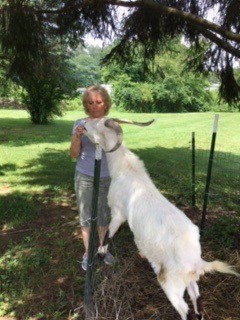
Ernie is a fainting goat, who does in fact faint! Because fainting goats like to be in packs, Mrs. Gonzalez and her two dogs have to spend a lot of time hanging out with Ernie to make him feel safe and secure. (Always the good therapist!)
Positive Psychology is the study of the traits and conditions that contribute to human flourishing and well-being.
Positive psychologists focus their attention on our strengths instead of our weaknesses. This focus has been shown to improve our happiness and our success in reaching our life goals.
At Aim Academy, we make the tenets of positive psychology part of our academy-wide culture. We want our faculty, students, and families to flourish by equipping them with an understanding of their innate strengths–like grit, a growth mindset, and resilience.
One of the main ways we accomplish this is through webinars and classes taught by Bonnie Gonzalez, a licensed and practicing family counselor.
Q. Bonnie, tell us a bit about your background and your goals for your students at Aim Academy?
As I troubled high school student, I wished for a teacher to guide me through some tough decisions and to help me make wise choices about my future. After spending 30+ years “doing” psychology as a counselor, I decided to become THAT teacher for high school students – someone who would use the principles of positive psychology to help students learn about their thoughts and behaviors, and to make good decisions.
I have always believed that if you love a subject you will learn it! In practice then, as a teacher, my goal is to help my students love the topics in psychology and sociology. In my classes we study everything from the areas of the brain that direct our behavior to the influence of the people and groups around us as we make decisions and gain our motivation. My job is to help my students discover the “whys” of what we do, and then look at the possible ways to channel their behavior toward something that is worthwhile and good.
Q: What do you enjoy most about teaching for Aim Academy?
There are several reasons I love teaching at Aim Academy. First is the interactions with students and parents. The size of the classes allows me to fully engage with each student and with his/her parents. Working together with open communication allows me to plan my class for the benefit of each student’s needs. I also enjoy teaching with Aim because of the interaction with faculty members and the freedom to explore new classes that might be helpful to our student population. Our faculty is open to new ideas and new courses that benefit our students.
Q. What got you through the pandemic?
Throughout the past year, I have spent lots of time reading psychology books – I guess reading would qualify as part of my pandemic relief. The pandemic also allowed me to spend quality time with family (since we were only seeing each other), without the hustle and bustle of life. Our conversations and time together were delightful. Finally, I got through the pandemic by spending lots more time in prayer and some quiet reflection.
Writing is a powerful learning tool for your homeschool.
#1 Write to Learn
One of the great mysteries facing homeschool parents is how to help kids become confident writers. In my experience, we often make this task harder than it needs to be. Mostly, kids just need time they can count on to write—and for three critical reasons. Writing is the art of transforming what we think into words. That process is the first reason writing should be a fundamental part of your homeschool program. Writing is a powerful learning tool—perhaps the most powerful one at your disposal. The secret to raising confident writers is having a regularly scheduled time where your kids write about what they are learning.
“I don’t know what to write!” We’ve all heard this complaint and experienced it ourselves. Yes, that is the crux of the issue – our kids don’t know what they think, what they believe, what they know, or what they understand. The real power in writing comes from their struggle to find the words to express their thoughts. That is when their brains are growing—making connections, pondering questions, sorting and classifying details and experiences—all to figure out what it is they have to say. Cheer your kids on with this truth—every moment they spend drafting and polishing an essay or story is building a better brain. The more kids write, the faster their brains will work. Research shows that kids who write are better learners (in all subjects) than kids who do not.
Test Me On This
Try this experiment for one week and see what results you achieve:
Once a day ask your kids to write for at least 15 minutes about what they are learning. Don’t limit this to school subjects. Everything they experience and read is fair game. The goal is to get them busy transforming their thoughts into words. Help them get started with these writing prompts:
What did you learn today that you didn’t know yesterday?
What did you think a lot about today? Why?
What did you read about today that you found interesting?
What did you study that you want to know more about?
What did you see, hear, smell, touch, and feel today that you want to remember?
Notice how once kids have a regularly scheduled time they can count on to write, they begin to have more to say and the words flow more quickly.
#2 Archive Their Childhood
What your children write captures their intellectual history. The stories, essays, and reports your kids create as they grow will become the archives of their childhood. The writing portfolios my own four children produced during our homeschooling years are among my most precious possessions. This amazing journey toward adulthood is worth capturing and treasuring forever. Do you mark your children’s physical growth on a wall in your home? In the same way, we should mark and celebrate their cognitive growth. Both are signs of God’s love and care in their lives.
Consider the experiences, books, and people your children will wish you had preserved memories of from their growing up years. Get them writing about these now! Yes, document all these memories with your camera phone, but then use the photos as writing prompts to get your kids’ creative juices juicing. It is fine to keep these assignments informal. It isn’t necessary to draft, revise, and polish everything children write. Writing every day is the goal. (I asked my four kids to work on a writing project four times a week. Fridays I reviewed what they wrote.)
Ask your kids to write about why something happened or how it affected them, in addition to answering the questions “who,” “what,” “where,” and “when.” The latter fact-based questions do not require kids to think as deeply about their experiences as the “why” and “how” questions do.
Read What They Write Often
Then take time each week to read and savor together what your kids have written. Talk about it. Ask them what they like best about each entry. Point out where you see improvement. Let them know what you enjoy and find most interesting. Seeing improvement is critical to anyone’s ongoing motivation, so be a cheerleader and enthusiastic writing coach. At least once a year take out your children’s previous writings and compare these with their current year’s work. Together notice how each child is growing as a thinker, learner, and writer.
#3 Capture Their Voices
In my opening letter to students in Writers in Residence, volume 2, I write “your ideas, memories, investigations, and stories are all part of what makes you you right now in this time and place—and that is worth saving.” That brings me to the third powerful reason kids need to write. . .
Writing gives voice to each child’s individuality. If there is one thing God obviously loves, it is our diversity. Throughout creation we see the abundance of His creative spirit overflowing—no two snowflakes alike; no end to the different species of plants and animals we discover. God is more glorified when we put what makes us unique on display. Forget about assigning those formulaic essays that you also hated to write in school. Instead focus on helping your kids express with words what only they have thought, experienced, or imagined. We need the God-given voice of each child to be captured, polished, and shared.
Language is an amazing grace from God and a gift to steward and revel in. When we teach children to write, the benefits of skill and confidence in crafting words will open doors for them and help lead them into their futures.
Cast a Vision for Writing
Most of us learned to write through meaningless assignments for a nonexistent audience. That is the main problem – writing should be authentic. Authentic writing always has a living, breathing reader on the other side. Whatever writing projects you assign in your homeschool, make sure your children are writing for real people that they care about and look forward to sharing their finished product with—Grandma, a writer’s group, friends, their family members, and you.
Give your children a vested interest in their writing projects by letting them choose what they write about. Even if you require them to tackle a specific form of writing, such as a research paper, personal essay, or opinion piece, make sure the topic is one that matters to them.
Cast a vision for God’s purposes and design in your children’s creativity. Inspire them to see writing as an expression of their individuality that God and you both love. Infuse your writing time with lightheartedness and freedom. While suggestions for improvement are helpful, grading a writing assignment is a stress-producing proposition. We all produce our best work when we are filled with enthusiasm and joy for the task at hand.
I have taught literature and writing for more than thirty years –online, in homeschool co-ops, and conventional classrooms–I’ve seen firsthand how becoming a confident writer powerfully impacts a child’s intellectual growth and self-esteem. I believe it is a holy calling to use God’s glorious gift of language to draw attention to His creativity and unique expression of Himself in each of us. I’d love to hear from you—what writing successes and struggles have you experienced in your homeschool? Anything I’ve missed in this post that you’d like to share? Connect with me on Facebook and at DebraBell.com.
Join My Mission — Raise a Writer in Residence
I’m passionate about helping parents raise writers in residence in their homeschools. I’d love to get your feedback about this article (give you some practice transforming your thoughts into words!) Connect with me at debrabell.com or join my Facebook group about raising a writer.
Debra Bell’s Aim Academy also offers writing-intensive English classes. See our selection here.