Use this planning grid to map out a high school homeschool program that ticks all the boxes.
I learned a nifty strategy from my kids’ math program one year: Work backwards. Since then, it’s become a life mantra. Want to end up in a happy career? Start at the end and figure out each of the necessary preceding steps along the way, one by one. Want to end up with a college-ready senior? Plan the senior year first, then the junior year, and so forth all the way back to 8th grade. This strategy will help you make sure you don’t skip something important and ensure you allow adequate time for the priorities.
Your high school plan will get revised many times, but keeping the current draft front and center will help you and your collegebound kid say no to opportunities not on the pathway. (A common pitfall is trying to do too many things during high school instead of a few things really well.)
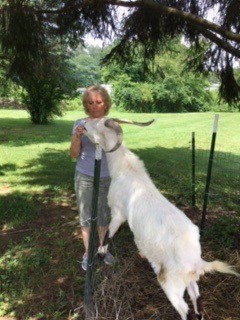
Ernie is a fainting goat, who does in fact faint! Because fainting goats like to be in packs, Mrs. Gonzalez and her two dogs have to spend a lot of time hanging out with Ernie to make him feel safe and secure. (Always the good therapist!)
Positive Psychology is the study of the traits and conditions that contribute to human flourishing and well-being.
Positive psychologists focus their attention on our strengths instead of our weaknesses. This focus has been shown to improve our happiness and our success in reaching our life goals.
At Aim Academy, we make the tenets of positive psychology part of our academy-wide culture. We want our faculty, students, and families to flourish by equipping them with an understanding of their innate strengths–like grit, a growth mindset, and resilience.
One of the main ways we accomplish this is through webinars and classes taught by Bonnie Gonzalez, a licensed and practicing family counselor.
Q. Bonnie, tell us a bit about your background and your goals for your students at Aim Academy?
As I troubled high school student, I wished for a teacher to guide me through some tough decisions and to help me make wise choices about my future. After spending 30+ years “doing” psychology as a counselor, I decided to become THAT teacher for high school students – someone who would use the principles of positive psychology to help students learn about their thoughts and behaviors, and to make good decisions.
I have always believed that if you love a subject you will learn it! In practice then, as a teacher, my goal is to help my students love the topics in psychology and sociology. In my classes we study everything from the areas of the brain that direct our behavior to the influence of the people and groups around us as we make decisions and gain our motivation. My job is to help my students discover the “whys” of what we do, and then look at the possible ways to channel their behavior toward something that is worthwhile and good.
Q: What do you enjoy most about teaching for Aim Academy?
There are several reasons I love teaching at Aim Academy. First is the interactions with students and parents. The size of the classes allows me to fully engage with each student and with his/her parents. Working together with open communication allows me to plan my class for the benefit of each student’s needs. I also enjoy teaching with Aim because of the interaction with faculty members and the freedom to explore new classes that might be helpful to our student population. Our faculty is open to new ideas and new courses that benefit our students.
Q. What got you through the pandemic?
Throughout the past year, I have spent lots of time reading psychology books – I guess reading would qualify as part of my pandemic relief. The pandemic also allowed me to spend quality time with family (since we were only seeing each other), without the hustle and bustle of life. Our conversations and time together were delightful. Finally, I got through the pandemic by spending lots more time in prayer and some quiet reflection.
Writing is a powerful learning tool for your homeschool.
#1 Write to Learn
One of the great mysteries facing homeschool parents is how to help kids become confident writers. In my experience, we often make this task harder than it needs to be. Mostly, kids just need time they can count on to write—and for three critical reasons. Writing is the art of transforming what we think into words. That process is the first reason writing should be a fundamental part of your homeschool program. Writing is a powerful learning tool—perhaps the most powerful one at your disposal. The secret to raising confident writers is having a regularly scheduled time where your kids write about what they are learning.
“I don’t know what to write!” We’ve all heard this complaint and experienced it ourselves. Yes, that is the crux of the issue – our kids don’t know what they think, what they believe, what they know, or what they understand. The real power in writing comes from their struggle to find the words to express their thoughts. That is when their brains are growing—making connections, pondering questions, sorting and classifying details and experiences—all to figure out what it is they have to say. Cheer your kids on with this truth—every moment they spend drafting and polishing an essay or story is building a better brain. The more kids write, the faster their brains will work. Research shows that kids who write are better learners (in all subjects) than kids who do not.
Test Me On This
Try this experiment for one week and see what results you achieve:
Once a day ask your kids to write for at least 15 minutes about what they are learning. Don’t limit this to school subjects. Everything they experience and read is fair game. The goal is to get them busy transforming their thoughts into words. Help them get started with these writing prompts:
What did you learn today that you didn’t know yesterday?
What did you think a lot about today? Why?
What did you read about today that you found interesting?
What did you study that you want to know more about?
What did you see, hear, smell, touch, and feel today that you want to remember?
Notice how once kids have a regularly scheduled time they can count on to write, they begin to have more to say and the words flow more quickly.
#2 Archive Their Childhood
What your children write captures their intellectual history. The stories, essays, and reports your kids create as they grow will become the archives of their childhood. The writing portfolios my own four children produced during our homeschooling years are among my most precious possessions. This amazing journey toward adulthood is worth capturing and treasuring forever. Do you mark your children’s physical growth on a wall in your home? In the same way, we should mark and celebrate their cognitive growth. Both are signs of God’s love and care in their lives.
Consider the experiences, books, and people your children will wish you had preserved memories of from their growing up years. Get them writing about these now! Yes, document all these memories with your camera phone, but then use the photos as writing prompts to get your kids’ creative juices juicing. It is fine to keep these assignments informal. It isn’t necessary to draft, revise, and polish everything children write. Writing every day is the goal. (I asked my four kids to work on a writing project four times a week. Fridays I reviewed what they wrote.)
Ask your kids to write about why something happened or how it affected them, in addition to answering the questions “who,” “what,” “where,” and “when.” The latter fact-based questions do not require kids to think as deeply about their experiences as the “why” and “how” questions do.
Read What They Write Often
Then take time each week to read and savor together what your kids have written. Talk about it. Ask them what they like best about each entry. Point out where you see improvement. Let them know what you enjoy and find most interesting. Seeing improvement is critical to anyone’s ongoing motivation, so be a cheerleader and enthusiastic writing coach. At least once a year take out your children’s previous writings and compare these with their current year’s work. Together notice how each child is growing as a thinker, learner, and writer.
#3 Capture Their Voices
In my opening letter to students in Writers in Residence, volume 2, I write “your ideas, memories, investigations, and stories are all part of what makes you you right now in this time and place—and that is worth saving.” That brings me to the third powerful reason kids need to write. . .
Writing gives voice to each child’s individuality. If there is one thing God obviously loves, it is our diversity. Throughout creation we see the abundance of His creative spirit overflowing—no two snowflakes alike; no end to the different species of plants and animals we discover. God is more glorified when we put what makes us unique on display. Forget about assigning those formulaic essays that you also hated to write in school. Instead focus on helping your kids express with words what only they have thought, experienced, or imagined. We need the God-given voice of each child to be captured, polished, and shared.
Language is an amazing grace from God and a gift to steward and revel in. When we teach children to write, the benefits of skill and confidence in crafting words will open doors for them and help lead them into their futures.
Cast a Vision for Writing
Most of us learned to write through meaningless assignments for a nonexistent audience. That is the main problem – writing should be authentic. Authentic writing always has a living, breathing reader on the other side. Whatever writing projects you assign in your homeschool, make sure your children are writing for real people that they care about and look forward to sharing their finished product with—Grandma, a writer’s group, friends, their family members, and you.
Give your children a vested interest in their writing projects by letting them choose what they write about. Even if you require them to tackle a specific form of writing, such as a research paper, personal essay, or opinion piece, make sure the topic is one that matters to them.
Cast a vision for God’s purposes and design in your children’s creativity. Inspire them to see writing as an expression of their individuality that God and you both love. Infuse your writing time with lightheartedness and freedom. While suggestions for improvement are helpful, grading a writing assignment is a stress-producing proposition. We all produce our best work when we are filled with enthusiasm and joy for the task at hand.
I have taught literature and writing for more than thirty years –online, in homeschool co-ops, and conventional classrooms–I’ve seen firsthand how becoming a confident writer powerfully impacts a child’s intellectual growth and self-esteem. I believe it is a holy calling to use God’s glorious gift of language to draw attention to His creativity and unique expression of Himself in each of us. I’d love to hear from you—what writing successes and struggles have you experienced in your homeschool? Anything I’ve missed in this post that you’d like to share? Connect with me on Facebook and at DebraBell.com.
Join My Mission — Raise a Writer in Residence
I’m passionate about helping parents raise writers in residence in their homeschools. I’d love to get your feedback about this article (give you some practice transforming your thoughts into words!) Connect with me at debrabell.com or join my Facebook group about raising a writer.
Debra Bell’s Aim Academy also offers writing-intensive English classes. See our selection here.
Some day you and your kids will tell your grandchildren how your family survived Covid-19. Start writing your unique story together now.
Under quarantine and conditions of uncertainty, homeschooling has different goals from those during normal times. Here’s how to lean into that . . .
Prioritize relationships.
When stressful conditions abound, focus on your family’s well being, safety, and health. Academics can wait. Kids will catch up later. The lesson right now is showing your children how to manage uncertainty, how to be there for one another, how to be good neighbors, and how to stay safe and healthy. This is a teachable moment like no other! Seize the day.
Attend to your own well being first.
Your kids are looking to you to set the tone and reaction to world events outside of our control. Attend to your emotional and spiritual needs first so you can support others. What does that look like for you? A quiet time of Scripture reading or meditation first thing in the morning? A consistent routine of exercise or morning walk? A chance to catch up with girlfriends in a casual Zoom meetup once a week?
It’s not heroic to deny yourself in these trying time. You may have a few superpowers (most home school moms do), but you aren’t super human–stress is depleting. Your family’s well being depends on your well being first.
Empathy is everything.
Empathy is the ability to understand and feel what another is experiencing, even if it is not how we are responding. It is stepping into the other’s shoes and coming alongside them in a way that validates their experiences.
When your children are afraid or angry about how the restrictions affect them, do you tell them they shouldn’t feel that way? Or do you say you understand? Do you admit you sometimes have those emotions too? Empathy is the latter, and it is empowering. Real change is more likely when our feelings are validated than when they are judged or dismissed. A lack of empathy from those who matter to us compound our negative emotions with shame and guilt. Now we are in an even deeper hole with no one to help us dig ourselves out.
Empathy is not a natural response when we’re all under stress and dependent on one another. We have to choose to be empathetic. Consider adding a regular time to the routine when family members can talk about how they are doing and each person can experience the affirmation and validation of others. Showing your kids how to express empathy toward parents and siblings is also part of this unprecedented teachable moment.
Once-in-a-lifetime memories.
Finally, what lasting memories can you make with your children right now? What will your unique pandemic family story be?
Sewing face masks for neighbors?
Creative social distancing events?
Making a scrapbook?
Completing a 1000 piece puzzle then framed for posterity?
Binge-watching a series together?
Learning a new game or hobby?
Applauding local health care workers?
It doesn’t have to be grand. It just has to be memorable, and then retold over and over again (just like your grandparents mined the Great Depression and WWII for all it was worth.) This is our moment, let’s make the most of it with our families.
My vivid memories from elementary school are the days we got tests back. As the teacher walked slowly around the room, we all tried to catch a glimpse of her face as she carefully put the tests face down on our desks. Fear of failure was the overwhelming emotion we felt as we quickly flipped the test over and glanced at the first page, looking just long enough to see the grade written in red marker. Of course, we didn’t want anyone else to see the grade, just in case it was bad. “Bad,” that was the operative word. If the grade was low, then it meant I was dumb or at the very least not smart enough to earn a good grade in that subject. Of all of the adjectives associated with failure, “bad” was the most profound. Even our parents knew that failure was bad.
But then I grew older and I learned that important, intelligent people like Thomas Edison, Albert Einstein, and athletes like John McEnroe (the tennis player who won the most matches in his career) all experienced significant failures. The word “failure” took on a new meaning. It became something that could happen to successful, intelligent people.
In recent years failure has taken on a more positive meaning. Researchers now know failure is something humans can learn from—it is considered a key path to healthy intellectual growth. In the words of growth mindset icon Carol Dweck, “Learning how to cope with failure can lead to humility, adaptation, and resiliency.”
But I have to ask myself, if failure is so important, then what happens to those of us who fear failure? And what happens to our children, influenced by our fears. Recent research into the concept of failure has shown that many of us who fear failure also have what is known as a fixed mindset. We see our failures as indicators that we don’t have what it takes to succeed. The other view, as identified by psychologist Carol Dweck, is a growth mindset. We see failure as a chance for growth, where learning can be enhanced.
Two sides of the same coin, summed up by Winston Churchill in his quote, “Success consists of going from failure to failure without losing enthusiasm.” Yes, according to this view failure is something positive and those of us from the fixed mindset generation must not only accept but even embrace the new definition. Even the biological evidence supports the finding that having a growth mindset is beneficial. Measuring brain waves at the Moser Psychophysiology Lab, Hans Schroder has observed that those who focus on trying to figure out a mistake, rather than fearfully avoiding it, quickly improve on tasks that require accuracy. According to Schroder, glossing over mistakes or shying away from them undermine our growth potential.
As homeschool parents, we can help our children view mistakes and failures in a new, more positive light. West Point Academy strategist Richard Bard suggests using an Action Review Approach. This includes asking the following question about a failure:
What actually happened?
What are three things that could have gone better?
What are three things that I did well?
Helping kids identify and evaluate failure, rather than fearing it, will improve their character, intellectual growth, and psychological well-being.
Bonnie Gonzalez has 36 years of experience as a licensed counselor and is passionate about helping families apply the latest research in their home schools. She teaches Introduction to Psychology, Intro to Sociology, and a series of mini-courses related to a positive psychology. See her classes here.
References
Hans S. Schroder, Megan E. Fisher, Yanli Lin, Sharon L. Lo, Judith H. Danovitch, Jason S. Moser. Neural evidence for enhanced attention to mistakes among school-aged children with a growth mindset. Developmental Cognitive Neuroscience, 2017; 24: 42 DOI: 10.1016/j.dcn.2017.01.00
Aim Academy offers both full year and seven week long math courses. You can find them all here.
Kathryn (Bell) Gomes was homeschooled herself and found that she was grossly unprepared for college-level mathematics. She now teaches homeschooled students math online so that they can avoid her mistakes. This fall she is teaching a live section of her SAT Math Prep course. Kathryn is the author of Apologia’s Exploring Creation with Mathematics elementary curriculum.